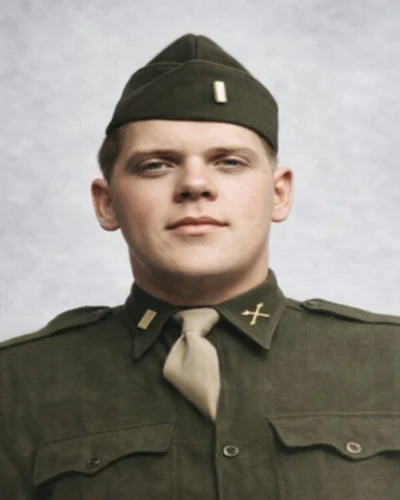
Robert A. Weatherford
1st Lt. Robert A. Weatherford
December 1944. The German offensive tears through the Ardennes. In the chaos of the retreat, a small column of anti-aircraft vehicles — Battery B of the 486th Anti-Aircraft Artillery (AW) Battalion — finds itself attached to a force that will go down in history: Task Force Hogan, commanded by Colonel Samuel M. Hogan, about 400 men cut off in the village of Marcouray, Belgium.
At the head of this section stands 1st Lieutenant Robert A. Weatherford. His half-tracks — an M15A1 with its 37mm cannon and an M16 with its four .50 caliber machine guns — are formidable weapons, designed to shred enemy aircraft but equally devastating against infantry. On December 21, his section is assigned to the 991st Field Artillery Battalion, directly alongside the Hogan column. The trap closes around all of them.
Christmas Night 1944
Five days of encirclement. No supply drops reach them — the parcels fall miles to the north. The walls tighten. On Christmas Day, the order comes: destroy everything, and leave on foot. Radios are smashed. Tires and tracks are slashed. Transmissions are filled with water. Ammunition is buried in an old well. One M15A1, one M16, one jeep — destroyed so the enemy gets nothing.
Then they walk. Fourteen hours. 14 kilometres through enemy territory, in the snow, in the dark. At one point, they pass through a German artillery battery in full operation — they can hear the battery executive giving firing orders. They hold their breath. They move without a sound.
"They walked for fourteen hours and covered about twenty-three miles; passing through a German artillery battery where they could hear the battery executive giving firing orders. Sgt. Sawtelle was the only B Battery man missing at the end of the march; he came out alone three days later."
— 486th AAA Battalion History, p. 129 — Primary source
The Last Man: Sergeant Sawtelle
When Weatherford's section finally crossed Allied lines at dawn on December 26, a single name was absent from the roll call: Sergeant Sawtelle. He had been separated during the march. Three days later, he emerged alone — having navigated his own path through enemy-held territory. Every man returned.
The 486th AAA Battalion
The 486th Anti-Aircraft Artillery (Automatic Weapons) Battalion (Self-Propelled) was a specialized mobile unit equipped with armed half-tracks, tasked with protecting armored and artillery formations from low-altitude air attack. Its M16 quad-.50 and M15A1 vehicles also proved devastatingly effective in ground fire against enemy infantry during the Ardennes campaign.
During December 1944, the battalion's batteries were dispersed across the Ardennes front to provide anti-aircraft coverage for the 3rd Armored Division's artillery battalions. Battery B — Weatherford's battery — was supporting the 54th and 991st Field Artillery Battalions, which placed his section directly within the perimeter that would become the Marcouray pocket.